
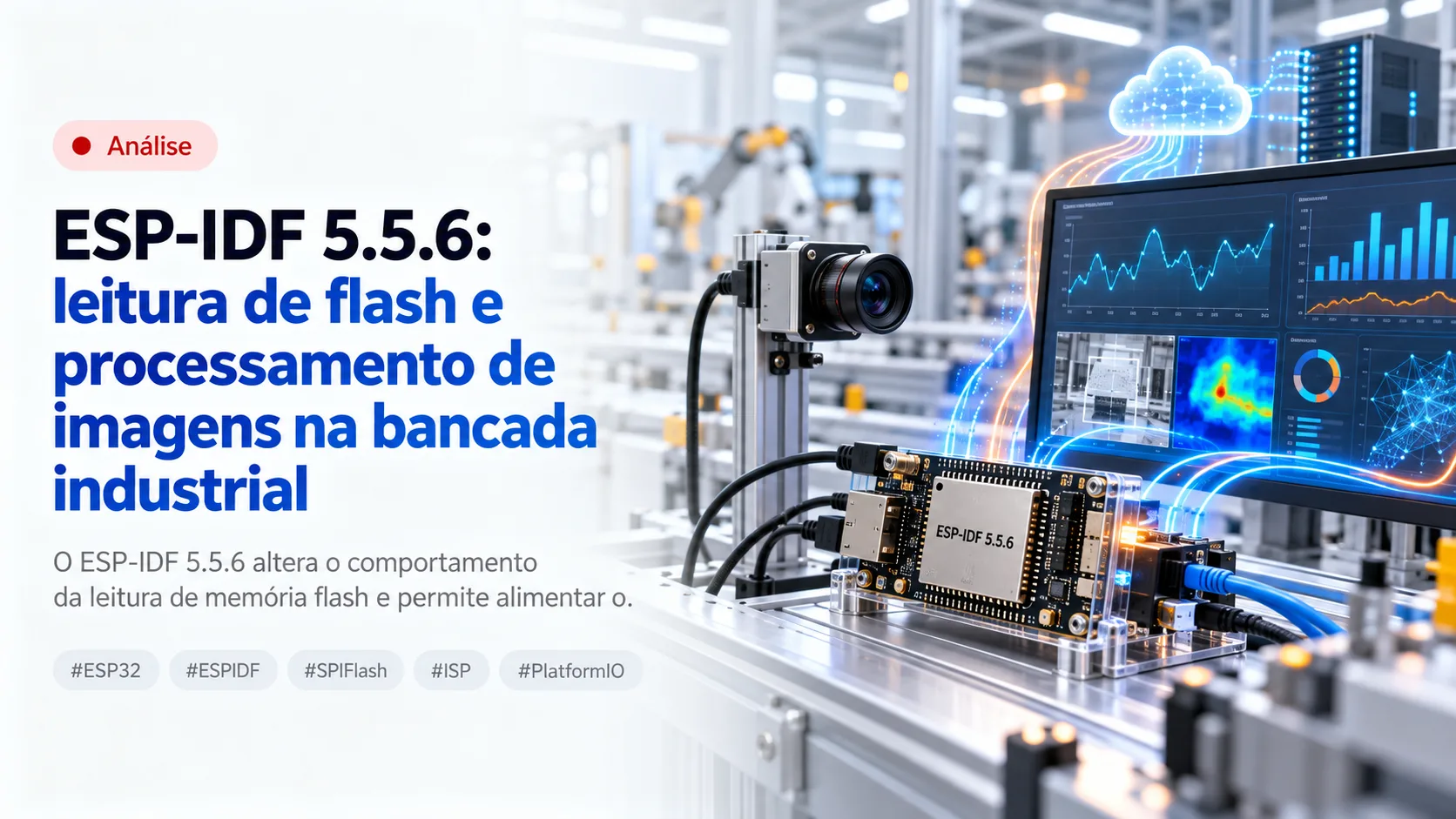
ESP-IDF 5.5.6: flash reads and image processing on the industrial test bench
ESP-IDF 5.5.6 changes flash memory read behavior and allows the image processor to be fed with data from memory. For equipment developers, this opens up testing options and requires reviewing dependencies before updating firmware.
Text generated automatically from the official sources listed below, without line-by-line human editorial review. Found an error? Tell the community.
In short
For developers building products with ESP32, ESP-IDF 5.5.6 brings changes to flash memory reads and image processing tests. Those maintaining equipment in the field also need to check for breaking changes before updating the embedded program. For hobbyists or those buying ready-made equipment, nothing changes automatically.
What it is
ESP-IDF is Espressif's official set of libraries and tools for developing firmware, the program that runs on the microcontroller. A release series brings together a development baseline and its updates. Espressif presents version 5.5.6 as a bug-fix update to the 5.5 series, but its release notes also list improvements and breaking changes. Official ESP-IDF 5.5.6 release notes.
Two improvements deserve attention on the test bench. The ISP, or image signal processor, now accepts RAW images from memory, without relying on a sensor interface for that input. RAW refers to image data that has not yet been converted into a final image for display. The other change concerns flash reads over SPI, a serial interface used for communication between the processor and external components. Flash is memory that retains data without power.
According to the release notes, flash read calls no longer disable the cache on chips other than the original ESP32. Cache is fast memory that stores copies of information accessed by the processor. The distinction between the original model and the other members of the family is essential: ESP32 is also used as a generic family name, but a change to a driver, the software layer that controls the hardware, may have a specific scope.
What it is for
Feeding image processing from memory allows two tasks to be separated: capturing a scene and processing its data. On a vision test bench, using a stored image as input helps repeat exactly the same stimulus. Changes in the result can then be investigated without the variation caused by lighting, part movement, or camera adjustments.
One example procedure is to save a reference capture of a part and reuse it during development. The input format must match what the image processor expects. This repetition helps verify the image processing path; it does not replace tests with an actual camera, lens, and lighting. Recognizing defects in the part remains the responsibility of the application algorithm.
For flash reads, the practical issue is concurrency between tasks. A device may read stored parameters while updating a display and receiving sensor data. Disabling the cache imposes restrictions on access to code and data that depend on it. Understanding when this happens helps with task design and investigating delays, even without attributing a performance gain to the new version.
Where it is used
In industrial automation, local image processing can play a role in reading indicators, checking presence, and visual inspection. The choice of processor, memory, and camera depends on the data volume and the deadline for producing a response. Initial image processing prepares the data; the decision to accept a part or trigger an alarm belongs to another stage of the system.
Development hardware combining processing and connectivity is available for this type of exploration. CNX Software describes the Adafruit Metro ESP32-P4 Hydra with ESP32-P4, ESP32-C6, and camera and display interfaces. This is an example of the hardware context in which visual processing and communication coexist. Coverage of the Metro ESP32-P4 Hydra.
Flash access, meanwhile, is relevant even in equipment without a camera. An industrial concentrator reads settings, certificates, and tables while exchanging messages. Modbus is a protocol used to query and control equipment; RS-485 is a differential electrical interface often used to carry its serial communication. MQTT is a publish-subscribe messaging protocol commonly used to send measurements to servers. These functions share microcontroller resources with storage.
Relevance for industry
Editorial view: the main reason to evaluate this update is to identify whether it affects a path the equipment actually uses. A vision application has a direct interest in image input from memory. A concentrator should examine its flash read routines and chip model. Priority comes from that match, not just the version number.
On a communication test bench, a useful test combines querying instruments, reading settings, and sending measurements. Record the time between request and response, communication losses, and application behavior under load. For a SCADA, a supervisory control and data acquisition system, what matters is receiving quality information within the time required by the process.
Separating responsibilities remains necessary. A message queue decouples acquisition from network transmission: the sensor can be serviced while a publication waits to be transmitted. The queue needs a limit and an explicit policy for handling saturation. No cache change alone can fix an application that blocks acquisition while waiting for connectivity.
Impact on embedded systems
Editorial view: image input from memory supports repeatable tests, while the change to flash reads warrants reviewing assumptions about interrupts and memory access. My assessment is that the most immediate benefit lies in improving the ability to measure and reproduce behavior. That is more useful to a product team than assuming an overall firmware speedup.
During development, record the tool versions, build options, and dependencies used. PlatformIO is an environment that organizes platforms, libraries, and build stages. In a project that uses it, the version of ESP-IDF actually installed depends on the selected packages. Stating that the project uses ESP-IDF does not, by itself, identify the version that generated the program.
For hardware, the distinction between physical capabilities and software support also needs to be reviewed. The release notes remove support for Key Manager, a cryptographic key management peripheral, on ESP32-C5, ESP32-P4, and ESP32-S31. The stated reason is that changes to the peripheral's design are needed before it can be offered as a production feature. Projects that depend on it need to review that dependency before migrating.
Limits and what is still missing
The sources provide no measurements that would justify promising lower latency, higher image processing throughput, or better communication performance. The cited change concerns flash reads: it should not automatically be extended to writing or erasing. RAW input also does not mean accepting any image file, nor does it make the ISP available on every chip in the family.
The article about the Hydra provides context for a board with imaging interfaces, but does not demonstrate that it has been validated with ESP-IDF 5.5.6 or the ISP's new input path. Likewise, the removal of Key Manager does not mean the removal of all cryptography from these chips. What needs to be checked is which feature the application uses and which software path provides it.
My recommendation for what to do now:
- Identify the chip and ESP-IDF version used in the equipment. - Locate dependencies on flash reads, image processing, and Key Manager. - Compare the current and updated firmware using the same workload and input data. - Check the packages resolved by PlatformIO when it is part of the project. - Keep a known working program and a recovery procedure before updating units in the field.