ESP-Mosaico: what AI-assisted creation changes in ESP32 prototyping
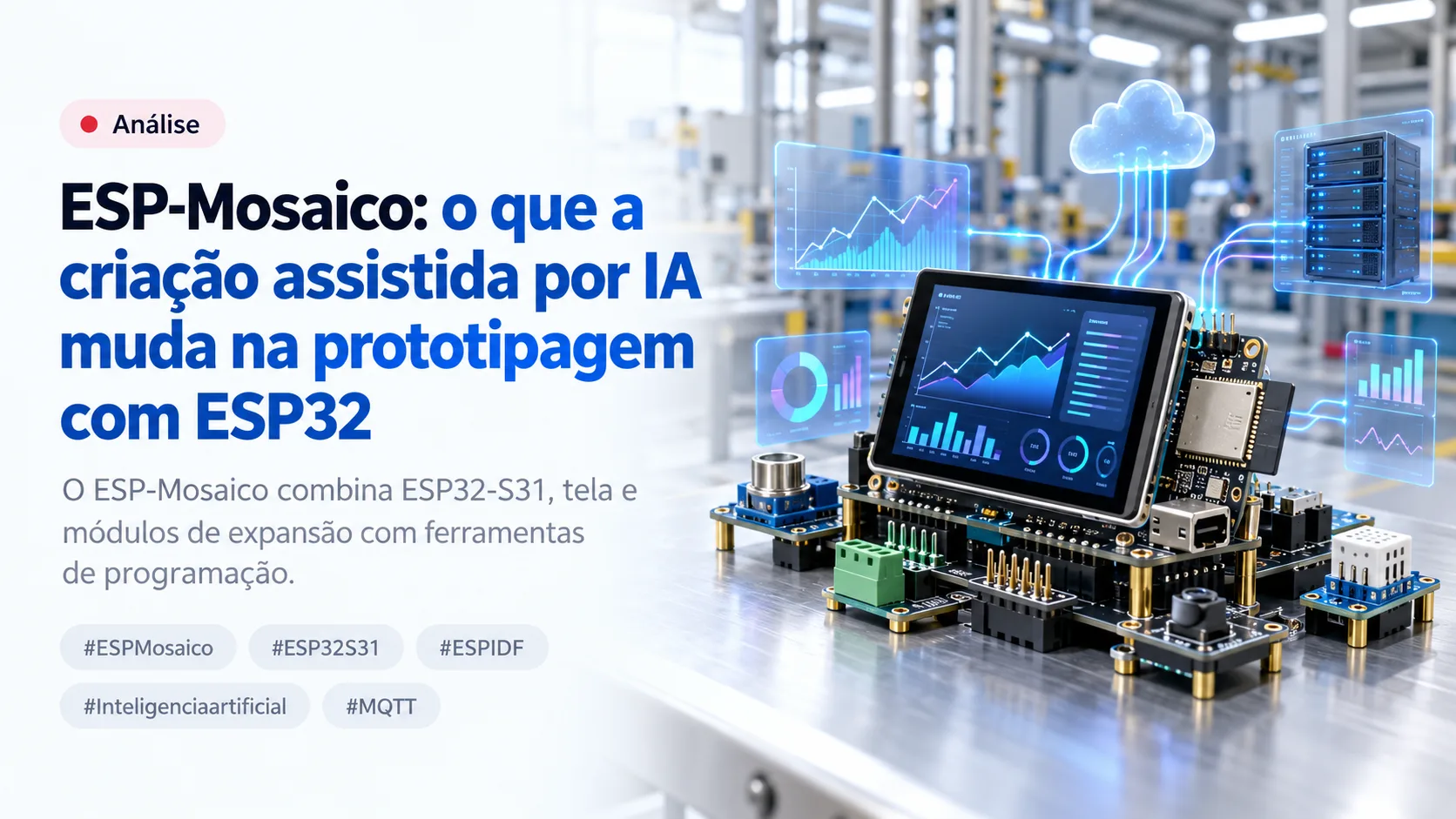
ESP-Mosaico combines ESP32-S31, a display and expansion modules with artificial intelligence-assisted programming tools. For product developers, the approach brings code generation closer to on-device testing; equipment already installed does not need to change.
Text generated automatically from the official sources listed below, without line-by-line human editorial review. Found an error? Tell the community.
In short
ESP-Mosaico brings together a board with a display, expansions and artificial intelligence tools to create applications on the device. For hobbyists and product developers, our view is that the approach makes it easier to try out an interface and check its behavior on the hardware. For those who maintain equipment in the field or buy off-the-shelf automation, the announcement requires no immediate changes.
What it is
Espressif announced ESP-Mosaico on October 20, 2026 as a modular platform for development assisted by artificial intelligence, or AI. At its core is the ESP32-S31, a microcontroller that runs programs and controls peripherals. The package includes a 480 × 480 pixel touchscreen, a battery and expansion through modules recognized by the system. These are the core elements presented in the Espressif announcement.
Modularity means adding functions through plug-in assemblies instead of redesigning the entire board for each experiment. A coding agent, in turn, is software that uses AI and tools to carry out development steps, such as editing code, compiling and analyzing failures. Compiling means transforming the program into a form the device can execute.
The approach brings these two ideas together: making the physical configuration known to the tools that produce the program. The manufacturer presents Chat Coding, development initiated through natural-language requests, and Vibe Coding, with agents also participating in implementation and hardware testing. The announcement places the platform within the ESP-IDF ecosystem, Espressif's collection of development libraries and tools.
What it is for
In an embedded prototype, a considerable part of the work lies between the idea and the first useful test. Connections need to be checked, components initialized, an interface built and the result observed. Module recognition and assisted code generation address this preparation. Embarcados coverage of ESP-Mosaico also presents this combination of physical expansion and programming tools.
As an engineering exercise proposed here, imagine a machine condition indicator. Before connecting it to the equipment, the team can feed the application simulated values and test three situations: normal operation, an exceeded limit and a lack of updates. The first goal is to check whether the operator understands the display and notices when the information is no longer reliable.
A useful specification for this exercise would say: show the value, unit and age of the reading; indicate loss of communication; keep navigation working during a network failure. Asking only for a “monitoring screen” leaves important decisions implicit. The quality of the prototype depends on translating intent into observable behavior, regardless of who writes the code.
Where it is used
Modular platforms with displays are used in education, concept demonstrations and interface evaluation before manufacturing a custom board. In automation, this work includes validating alarm organization, diagnostic messages and an instrument's configuration sequence. An interface can be electrically correct and still lead the operator to interpret an old reading as current.
In Industrial Internet of Things, or IIoT, projects, a common pattern is to separate data acquisition from presentation. A device close to the process collects measurements; another component receives the data and displays it. MQTT is a messaging protocol used for this communication: devices publish information to channels called topics, and an intermediary server, the broker, delivers the messages to interested parties. This is a typical architecture for the technology, presented here as a design reference.
When the data source is an industrial instrument, there may be an earlier stage using Modbus, a protocol that organizes queries and responses about values and states. RS-485 is an electrical interface often used to carry this communication over cables. Connecting it to the microcontroller requires a transceiver, a component that adapts the electrical signals; protection and isolation are specified according to the installation. Screen design and electrical integration are distinct parts of the same system.
Relevance for industry
Editorial view: the appeal of ESP-Mosaico for automation lies in the possibility of shortening bench evaluations of interfaces and behaviors. A team can discover early that a stale-data indicator is missing or that a command requires confirmation. Correcting these decisions before finalizing the hardware avoids carrying an operational problem into the final product.
An acceptance criterion should describe what happens in the event of a specific failure. If communication drops, the application needs to distinguish the last known value from a new measurement. If a restart occurs, it must restore the configuration consistently. If remote commands are available, acknowledgment of receipt must be distinguished from confirmation of physical execution.
SCADA systems, used for supervisory control and data acquisition, depend on these distinctions. Displaying a number on the screen is not enough: its source, unit, validity and communication status must be known. These requirements should guide the prototype from the outset, because a visually convincing demonstration can hide incomplete integration.
Impact on embedded systems
Editorial view: the most relevant aspect of this approach is bringing the tool that changes the program closer to the device that reveals the errors. This can make experimentation more useful, provided the developer preserves the requirements and reviews the changes. In firmware work—the program embedded in the equipment—the ability to reproduce the test and explain why a particular change was accepted becomes more important.
A robust structure separates acquisition, communication and the interface. Acquisition records values and failures; communication transports messages; the interface presents the available state. Queues and explicit states allow these parts to cooperate without depending on a single blocking sequence. This means a reconnection attempt does not need to interrupt screen updates or input readings.
Identifying a module is also no substitute for electrical design. The developer needs to check the power supply, available current, signal levels and pin sharing. On the software side, they must retain the source code, build configurations and dependency versions. These records make it possible to rebuild the program that was actually tested.
For teams using PlatformIO, an environment that organizes projects, builds and libraries, evaluating a new board starts with support for the microcontroller and the components used. A reproducible project needs to combine a board definition, build tools and compatible libraries. The convenience of the working environment depends on this technical foundation.
Limits and what is still missing
The sources consulted do not establish ESP-Mosaico's qualification for permanent industrial installation, immunity to interference or use in safety functions. They also do not demonstrate ready-made integration with Modbus, RS-485 or SCADA. The architectures discussed in this article are engineering references and evaluation proposals, not industrial features announced for the product.
The presence of ESP-IDF in the ecosystem does not prove immediate support in PlatformIO. The information used here also lacks comparable productivity and reliability measurements that would allow the benefits of agents to be quantified. Assisted generation does not mean that all stages work without external services, or that a test performed by the agent covers the application's failure modes.
Our recommendation is to follow the support documentation, the modules' operating conditions and the ability to reproduce projects outside a demonstration. The next useful step is a small trial with a verifiable result and no dependency on a machine in production.
What to do now:
- Define a simple interface and its operating, failure and recovery states. - Check software support, connections and electrical limits for the selected modules. - Test communication loss, restarts and stale data. - Archive code, dependencies and results before expanding the prototype.