
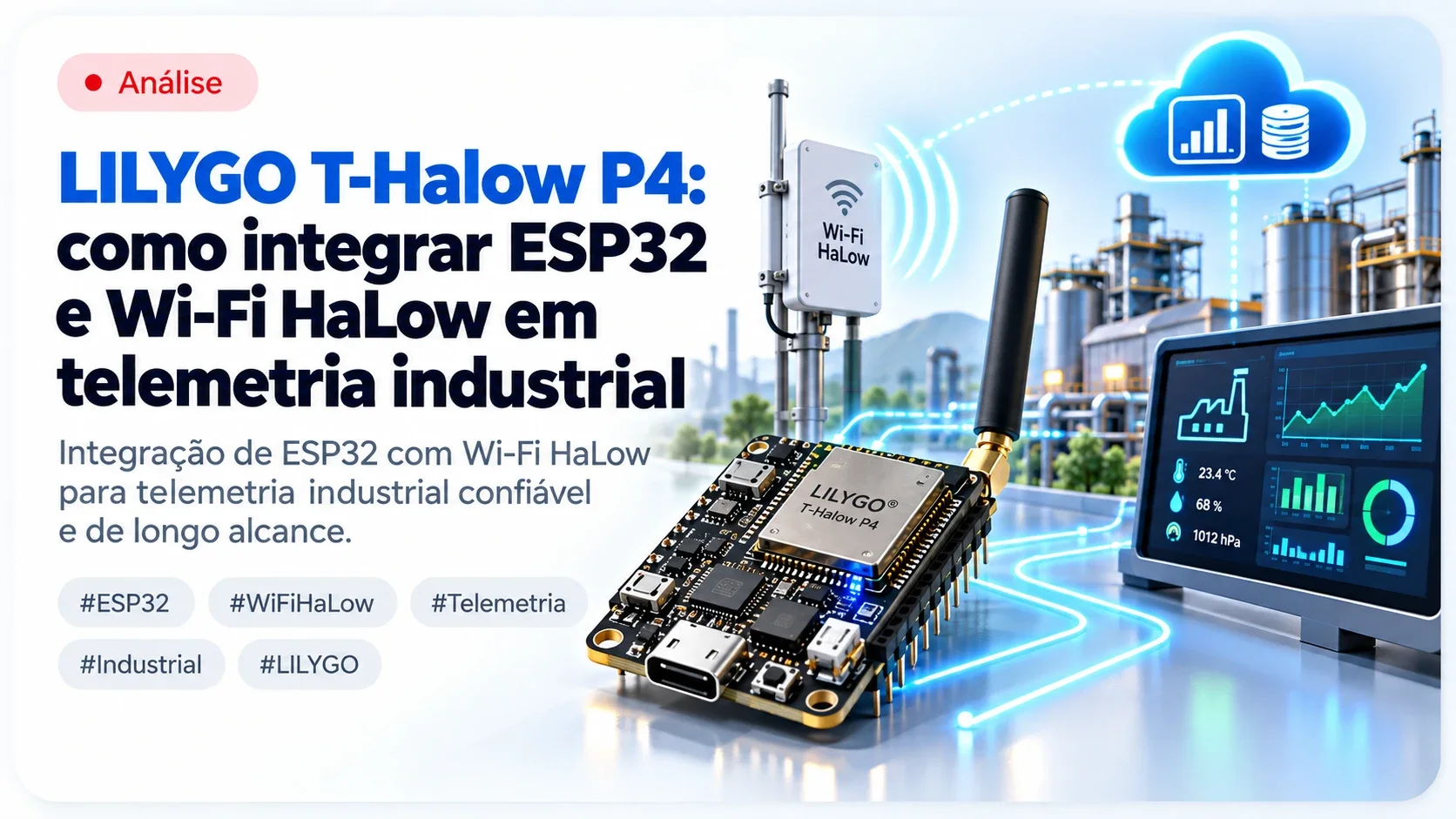
LILYGO T-Halow P4: how to integrate ESP32 and Wi-Fi HaLow into industrial telemetry
The T-Halow P4 brings together ESP32-P4, ESP32-C6 and a Wi-Fi HaLow module on a compact board. For developers of industrial telemetry systems, it offers a foundation for experimenting with wireless communication across large areas, with work required on electrical integration, software and field validation.
Text generated automatically from the official sources listed below, without line-by-line human editorial review. Found an error? Tell the community.
In short
For developers of monitoring equipment, the LILYGO T-Halow P4 offers a compact foundation for experimenting with longer-range Wi-Fi using ESP32. Our assessment is that it deserves a bench test when running cables to sensors is difficult. For those keeping an installation running, this new board does not call for any immediate replacement.
What it is
The T-Halow P4 is a development board that combines the ESP32-P4 microcontroller, responsible for application processing, an ESP32-C6 for wireless communication and a Taixin TX-AH module with Wi-Fi HaLow. The overview published by CNX Software places this combination in an M.2 2280 form factor, with dimensions of 80 × 22 mm. M.2 is a family of module form factors and connectors; here, the connector allows the board to be integrated into a custom carrier board.
Wi-Fi HaLow is the commercial name for the technology based on the IEEE 802.11ah standard. It operates at frequencies below 1 GHz, unlike the Wi-Fi networks most commonly found in homes and offices. Lower frequencies favor propagation in many situations, but the result also depends on antennas, obstacles, power and noise. HaLow remains a networking technology: transporting data is a different function from interpreting a measurement or controlling a machine.
The appeal of this architecture lies in the division of responsibilities. The processor runs the equipment's logic, while dedicated components handle the radio links. This arrangement makes it possible to build an application that collects data, maintains a local interface and communicates with other equipment without concentrating every function in a single circuit. The concrete innovation is the combination of these elements on the board presented, as described in the CNX Software coverage.
What it is for
The typical problem is transporting measurements between a remote location and the supervisory network. Consider a reservoir located away from the maintenance building: the local equipment needs to acquire level and temperature readings, identify sensor faults and forward that information. A wireless connection can reduce the need for construction work to route cables. This is an example of an architecture to evaluate, not a demonstrated T-Halow P4 installation.
To organize messages, an application can use MQTT, a protocol in which devices publish data to an intermediary server called a broker. The supervisory system subscribes to the topics it needs to monitor. The HaLow link carries the communication; MQTT defines how application messages flow between producers and consumers.
The design should treat loss of communication as a normal operating condition. Each measurement needs to carry a timestamp, identification and a validity indication. If the link goes down, a local queue can preserve records until reconnection. The size of that queue and the discard policy should reflect the process: an old temperature reading may have historical value, but it should not appear as the current temperature.
Where it is used
Wireless telemetry networks are used to monitor utilities, agricultural facilities, warehouses and equipment distributed across outdoor areas. In these applications, the amount of data is usually less important than continuity of collection and the ability to recognize outdated information. A well-designed installation measures communication quality at the actual locations, with machinery and obstacles present.
Another common architecture connects existing instruments to a device that bridges networks, called a gateway. Modbus is a communication protocol widely used to read registers in instruments and controllers. RS-485 is an electrical interface for differential transmission, frequently used to carry Modbus RTU, its serial mode. These are distinct layers: knowing a register address does not resolve the cable's electrical connection.
In this type of design, the RS-485 interface requires an appropriate transmitter and receiver circuit, along with protection and, depending on the installation, electrical isolation. The gateway queries the instruments and forwards the results to SCADA, a supervisory control and data acquisition system. The conversion also needs to preserve units, scales and fault states; publishing a number without reporting that the instrument has lost communication creates a false sense of normal operation.
Relevance for industry
Editorial view: the T-Halow P4 deserves attention as an evaluation platform for monitoring points where installing wired infrastructure is expensive. The first trial should use a variable with no safety function and compare availability, delivery time and maintenance effort with the existing solution. This comparison is more useful than selecting equipment based solely on its promised range.
Telemetry and control have different requirements. Recording water consumption tolerates delays that a motion control loop cannot tolerate. Critical commands need defined local behavior when communication is lost. The supervisory network should inform and coordinate the process within established requirements, while interlocks and safety functions follow their own architecture.
Industrial evaluation also includes recovery after a power outage, remote diagnostics and unit replacement. A technician needs to distinguish between a sensor fault, network loss and an application hang. Reconnection counters, the age of the last valid reading and a record of the reset cause make this distinction possible and reduce field visits made solely to find out what stopped working.
Impact on embedded systems
Editorial view: for product developers, the main task becomes coordinating the components and ensuring predictable recovery. The combination of processor and radios helps distribute functions, but requires a clear initialization sequence, supervision of each interface and handling of partial failures. An unavailable radio should not prevent local acquisition of a quantity that remains accessible.
In the firmware, the program embedded in the device, it is advisable to separate acquisition, storage and transmission. One task collects and validates the data; another maintains the queue; a third sends anything pending. Timeouts prevent a network operation from blocking the entire device. The supervisory mechanism known as a watchdog should detect a lack of actual progress, rather than merely receive periodic signals from a routine that keeps running while the application is stuck.
ESP-IDF is Espressif's collection of libraries and tools for developing applications on these microcontrollers. Controlling its version is part of product maintenance. As a concrete reference for dependency analysis, the official ESP-IDF v5.5.6 release notes record the removal of support for the Key Manager peripheral on ESP32-P4 because changes to the hardware design are required. This peripheral is related to cryptographic key management; the change should be included in the assessment of any project that intended to use it.
PlatformIO, an environment that organizes builds, dependencies and firmware flashing, also requires a combination of packages compatible with the project. Pinning versions and saving the build configuration makes it possible to reproduce the program installed in the field. On the hardware side, the same rigor applies to the carrier board: pinout, power supply, antenna placement and interface protection need to be treated as part of the product.
Limits and what is still missing
The selected sources do not demonstrate T-Halow P4 performance in a Brazilian factory, continuous link availability or behavior under industrial interference. Nor do they confirm, for this analysis, regulatory approval of the commercial configuration in Brazil, industrial environmental qualification or ready-to-use support in PlatformIO. The ESP-IDF release notes are a reference about Espressif's software, not a statement that this version is compatible with every component on the board.
The M.2 form factor does not guarantee that the board can be installed in any computer with a similar slot. Mechanical, electrical and protocol compatibility must be checked separately. Likewise, Wi-Fi HaLow requires compatible infrastructure at the other end: a conventional Wi-Fi access point does not gain the ability to receive HaLow simply because it shares the Wi-Fi brand.
What to do now:
- Define which data will be transmitted, the maximum acceptable age of each reading and behavior during an interruption. - Check the radio variant, regulatory approval documentation and pinout before purchasing or designing the carrier board. - Reproduce communication on the bench with pinned software dependencies and recovery after power is cut. - Measure the link at the installation site, including obstacles and actual operating conditions. - Approve a monitoring pilot after validating diagnostics, temporary storage and reconnection.