
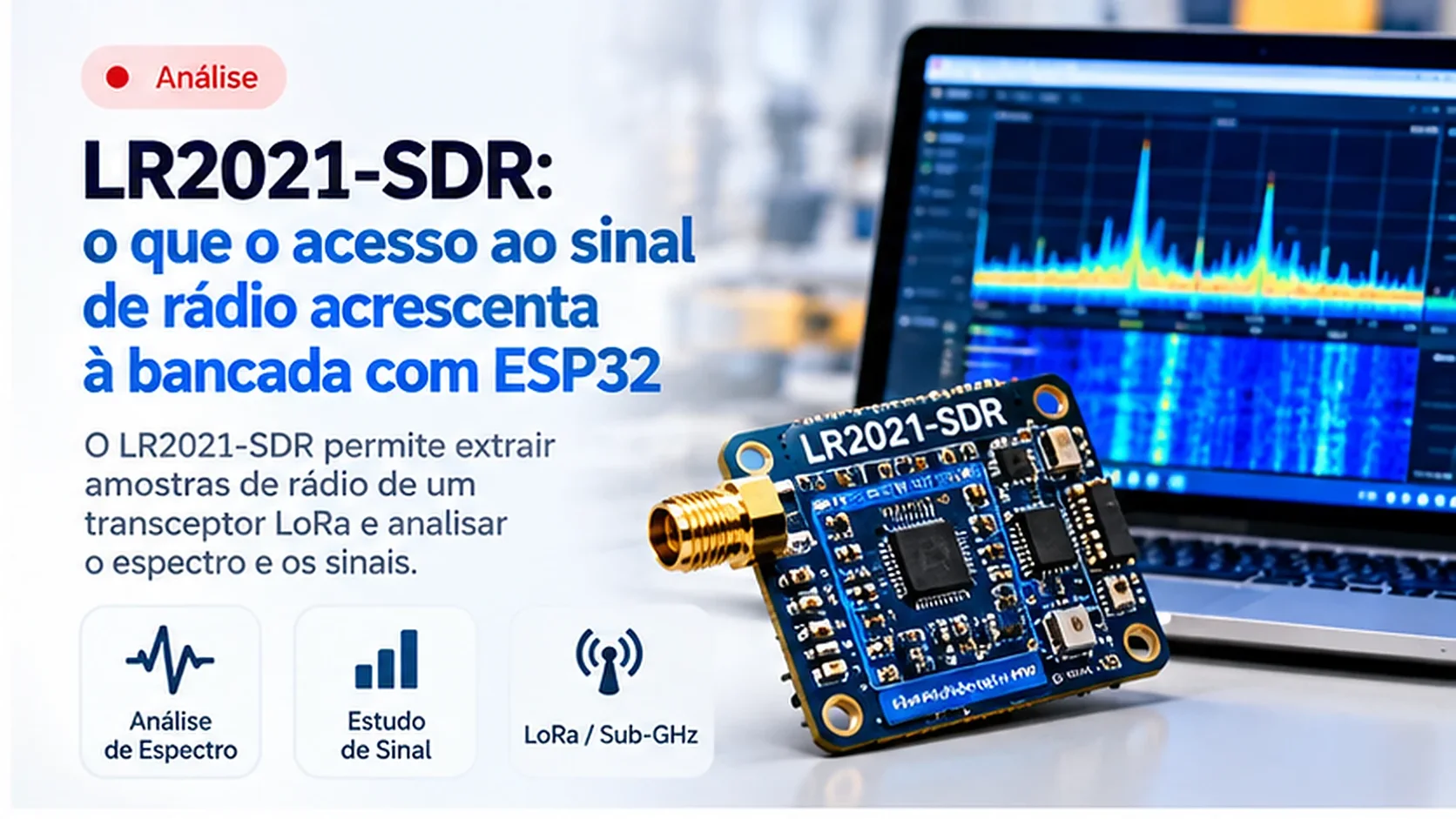
LR2021-SDR: what access to the radio signal adds to the ESP32 workbench
LR2021-SDR lets you extract radio samples from a LoRa transceiver and analyze them in software. For developers of ESP32-based sensors, it opens up an avenue for bench investigation; the experimental tuning range does not equate to guaranteed field performance.
Text generated automatically from the official sources listed below, without line-by-line human editorial review. Found an error? Tell the community.
In short
For developers of wireless sensors, LR2021-SDR is worth evaluating as an experimental bench tool. It lets you examine the signal received by the radio, beyond the packets delivered ready to use to the program. This does not make it a mandatory upgrade for those maintaining equipment in the field. For hobbyists, the appeal lies in learning radio processing with compatible hardware.
What it is
The LR2021 is a transceiver from Semtech: a component that transmits and receives radio signals. It works with LoRa, a modulation technique that represents data through controlled variations in the signal and is used for long-range communications. LoRa is not synonymous with LoRaWAN, which adds communication rules and a network architecture.
The open LR2021-SDR project, by Samuel Reynolds, uses an undocumented command to access signal samples. SDR stands for software-defined radio: part of the work of interpreting the transmission is shifted to software. The news comes amid other projects exploring integrated radios in this way, as documented in CNX Software's coverage of W1700K-SDR.
The samples are called I/Q, short for in-phase and quadrature components. These are two complementary representations that preserve amplitude and phase information from the signal converted for processing. Software uses this data to search for transmissions, visualize their frequency occupancy, and recover encoded information.
According to the report on LR2021-SDR, the project includes capture firmware for ESP32-P4 and demonstrated experimental reception between 100 MHz and 2.74 GHz. Firmware is the program running on the embedded device. In this architecture, the LR2021 receives the signal and the ESP32-P4 participates in data acquisition.
What it is for
A radio used conventionally delivers packets that have already been interpreted. This simplifies the application: the program receives a temperature message and forwards it to the monitoring system. However, when a transmission is not recognized, the expected packet may simply never appear. I/Q samples let you investigate a stage before message delivery.
Consider a bench setup with a sensor that transmits when triggered. The test can record the trigger time and look for corresponding radio activity. The developer then checks whether the signal is at the expected frequency, whether its duration makes sense, and whether there is another nearby transmission. This is a typical use of radio capture, useful for separating transmission, reception, and interpretation problems.
Another benefit is saving a capture and processing it again on a computer. This allows different filters and detection methods to be compared using exactly the same input. It makes diagnosis more reproducible than trying to manually recreate intermittent interference.
Where it is used
In industrial automation, radio analysis is part of investigating wireless sensors, telemetry, and communication between equipment. In a pumping installation, for example, message losses may be associated with antenna placement, obstacles, or competing transmissions. Observing the signal helps formulate hypotheses that then need to be tested under controlled conditions.
It also has applications in developing the equipment itself. Power converters, digital clocks, and cables can produce unwanted emissions. Comparing captures with different circuits switched on helps locate a possible noise source. Distance, antenna, and gain settings must remain the same for the comparison to be meaningful.
Radio analysis operates at a different layer from supervisory monitoring. MQTT is a messaging protocol organized by topics, used to transport data between applications. SCADA is the supervisory control and data acquisition system that presents variables and alarms to the operator. In a diagnostic architecture, events and indicators derived from captures can reach these tools, while raw records remain on the bench or in dedicated storage.
Relevance for industry
Editorial view: the industrial appeal of LR2021-SDR lies in expanding the possibilities for investigation during development. For a team already working with compatible hardware, it is worth evaluating a separate bench setup to study communication failures before changing parameters on the production network.
The first engineering step is to formulate a testable question. For example: does the transmitter actually transmit when the program reports that it has sent a message? Does the observed activity coincide with the loss of reception? A capture guided by these questions is usually more useful than accumulating files without recording the test conditions.
It is important to distinguish tuning frequency from instantaneous bandwidth. The former indicates where the receiver can be tuned. The latter determines how much of the spectrum it observes at once. A receiver capable of tuning to widely separated regions does not necessarily monitor all of them simultaneously. For short events, choosing the observation point and capture timing is part of the test method.
Impact on embedded systems
Editorial view: for firmware developers, the main shift in perspective is moving from occasional messages to a continuous data stream. In my assessment, the quality of this acquisition chain deserves as much attention as the algorithm that interprets the radio signal.
SPI, the synchronous serial interface used to connect components, carries the samples between the radio and the processor. Effective throughput depends on both the bus and the time spent on commands, transfers, and processing. A buffer, a region of memory that temporarily holds data, absorbs brief delays; it does not solve an output that is persistently slower than the input.
An acquisition implementation should separate sample retrieval, storage, and presentation of results. Updating a display or writing files must not delay reading the radio indefinitely. Loss counters and configuration records help distinguish signal defects from failures introduced by the instrument itself.
For hardware designers, the antenna and the circuits between it and the transceiver remain critical. Filters select frequency bands, and matching networks facilitate power transfer. Exploring new modes through software does not automatically change these physical characteristics. The entire board needs to be considered when interpreting a capture.
Limits and what is still missing
The coverage reviewed presents LR2021-SDR as experimental and reports tests on a single board, without establishing calibrated sensitivity across the entire range explored. Sensitivity is the ability to receive weak signals under defined conditions. Detecting a signal at a particular frequency does not, by itself, demonstrate adequate performance for an industrial link at that frequency.
The selected sources are technical reports; there is no primary documentation specific to LR2021-SDR among the candidates provided. They do not support a promise of compatibility with any ESP32 board, sustained stability in the field, or replacement of calibrated instruments. Access through an undocumented command also requires attention to the component revision and reproducibility of results.
My recommendation is to start with bench reception and treat any conclusion as a result of the conditions actually measured. What to do now:
- Identify the board, transceiver, and revision used in the test. - Define a diagnostic question and use a known reference signal. - Record frequency, gain, antenna, and any sample losses. - Repeat the capture before attributing a failure to the equipment being observed.