
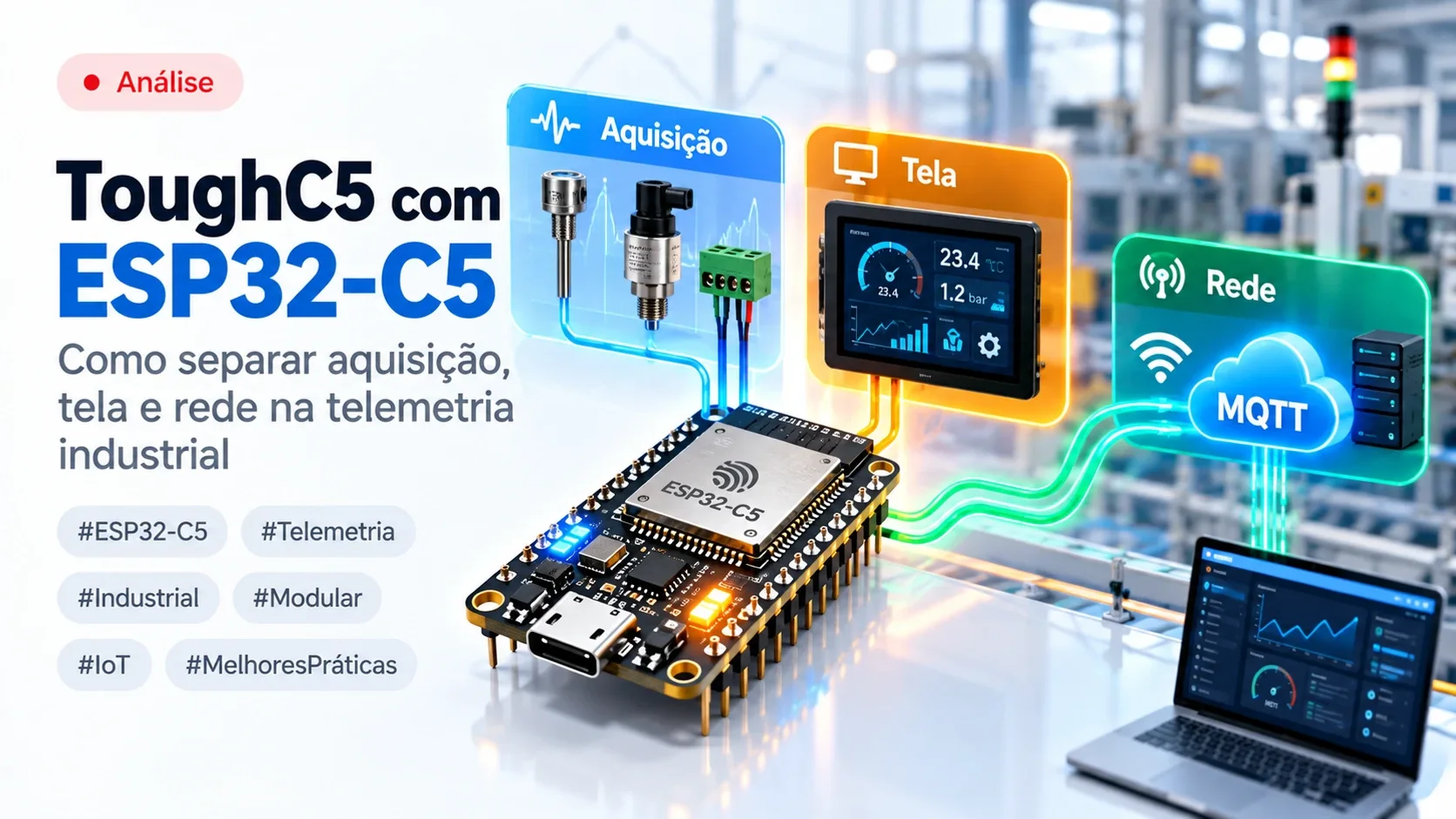
ToughC5 with ESP32-C5: how to separate acquisition, display, and networking in industrial telemetry
The M5Stack ToughC5 combines ESP32-C5, a touchscreen, and RS-485 in a compact device. For industrial telemetry developers, it brings data acquisition and local visualization together; reliability depends on how the software handles communication failures and stale data.
Text generated automatically from the official sources listed below, without line-by-line human editorial review. Found an error? Tell the community.
In short
For industrial telemetry product developers, the ToughC5 combines wired data acquisition, wireless connectivity, and touchscreen operation in a compact device. Our view is that the benefit lies in building a terminal that keeps the operator informed when the network goes down. For those maintaining equipment in the field, this requires separating acquisition, presentation, and transmission in the software. For hobbyists who only need to read a sensor, this architecture may be unnecessary.
What it is
The M5Stack ToughC5 is a connected controller based on the ESP32-C5, a microcontroller that runs the program and integrates wireless communication. The introduction published by CNX Software on October 10, 2026 describes an evolution of the M5Stack TOUGH, with a two-inch touchscreen, an RS-485 interface, and Wi-Fi 6 in the 2.4 and 5 GHz bands. This combination brings instrument connectivity closer to the interface used by the operator. The news article is available on CNX Software.
RS-485 is an electrical communication standard that transmits information through the voltage difference between conductors. It is common in installations with multiple instruments on the same cable. Wi-Fi connects the terminal to the local network without that data cable. The screen allows measurements and status information to be checked directly on the device, without relying on a remote computer.
These elements occupy different layers. The electrical interface carries signals; the protocol defines how to interpret messages; the application decides what to measure, store, and display. This distinction is central to the Industrial Internet of Things, or IIoT: connecting a device is only useful when the system preserves the meaning and validity of the data.
What it is for
A terminal with this combination of interfaces brings measurements and diagnostics closer to the person standing beside the installation. Consider a typical application: monitoring a tank whose instrument provides its level over Modbus RTU. This protocol organizes queries and responses over serial communication and is frequently carried over RS-485. The program queries the instrument, interprets the registers, and displays the level on the screen.
To send the same information to another system, the application can use MQTT, a messaging protocol in which clients publish and receive data through a server called a broker. The path is clear: the instrument supplies the measurement, the terminal maintains a local representation, and the MQTT client publishes updates. This is an application architecture, not a ready-made function attributed to the ToughC5.
The decisive detail emerges when a failure occurs. If the broker becomes unavailable, acquisition must continue and the screen must indicate the lost connection. If the instrument stops responding, the last level received must not continue to look like a current measurement. The value, the time of the reading, and the communication status need to travel together within the program.
Where it is used
This architecture is common in utilities supervision, tank monitoring, meter reading, and auxiliary machine monitoring. A local terminal helps distinguish two problems that look identical when viewed only from the control room: the instrument has stopped responding, or the path to the server has been interrupted.
A SCADA system, short for supervisory control and data acquisition, can receive the information through an appropriate integration. It brings together displays, alarms, and historical records from different points in the installation. At the field end, the terminal must also provide data quality: an old measurement must not be fed into the supervisory system as though it had just arrived.
Offline operation deserves an explicit policy. For a monitoring variable, storing the most recent value may be enough. For a process history, it may be necessary to maintain a queue of records with acquisition timestamps. When the network returns, the application needs to distinguish sending the current state from recovering old records, preventing delayed data from being presented as the current situation.
Relevance for industry
Editorial view: the appeal of the ToughC5 lies in the possibility of reducing the assembly work needed for a local supervisory terminal. For an automation engineer, the most useful evaluation starts with the response to failures: what will the operator see if the instrument cable breaks, the access point shuts down, or the server stops receiving messages? These answers define operational usefulness more than the number of interfaces brought together in the enclosure.
In a Modbus RTU implementation, each query must have a response timeout and a retry limit. An absent instrument must not indefinitely consume the time allocated to the others. It is also necessary to check the register map, the variable scaling, and the byte order used by the instrument. Receiving a valid response does not guarantee that the value is being interpreted correctly.
The electrical communication network requires the same care. Cable topology, termination at the ends, and bus biasing need to be planned. Biasing establishes a defined electrical state when no transmitter is active. In installations subject to potential differences between devices, galvanic isolation interrupts unwanted conductive paths between circuits; the need for it must be considered in the installation design.
The separation between supervision and protection must also be reflected in the architecture. A connected screen can display alarms and send operational requests. Safety functions require risk analysis and a solution suited to the function, including its behavior during failures. The presence of a microcontroller with a radio does not define that behavior.
Impact on embedded systems
Editorial view: for those writing firmware, the program embedded in the device, this type of terminal brings together responsibilities that need to be decoupled. Our recommendation is to organize acquisition, screen updates, and network communication into tasks with clear boundaries. A lengthy connection attempt must not delay the next instrument query or prevent a failure indication from reaching the operator.
A common implementation uses queues to exchange messages between tasks. The acquisition task produces a record containing the value, timestamp, and quality. The visual interface reads this state and presents it. The network task manages connection and publication. Queues need bounded capacity and a policy for when they fill up: discarding intermediate states may be acceptable for a screen, but losing alarm events requires different handling.
For storage, writing each sample directly to flash memory increases the number of writes. Flash is nonvolatile memory that preserves data without power and has a finite write endurance. Grouping records and defining a retention policy helps control this wear. The strategy also needs to account for power interruption during writing and data recovery after restarting.
The software foundation is part of this analysis. ESP-IDF is Espressif's set of tools and libraries for developing applications. Version 5.5.6 was published as a bug-fix release in the 5.5 series, according to the official repository. A release series groups related releases from the same codebase; choosing one is a separate decision from selecting the terminal.
In projects organized in PlatformIO, a tool for environment management and building, record the versions of the platform, libraries, and environment used to build the program. Approval of an update must include serial communication, the screen, storage, and recovery after network loss. Successful compilation demonstrates that the code was built; bench testing verifies whether the complete system maintains the expected behavior.
Limits and what is still missing
The CNX Software description reports basic water and dust resistance, with no declared IP rating and no indication of suitability for immersion. IP is a code that classifies enclosure protection against the ingress of solids and water. Therefore, a commercial description of weather resistance does not replace an assessment of the environment, mounting, and cable entries. The same article does not establish galvanic isolation of the RS-485 interface or qualification of the complete unit for a specific industrial installation.
The sources used do not confirm a ready-made Modbus-to-MQTT application, direct integration with SCADA, or a validated combination of ToughC5, ESP-IDF 5.5.6, and PlatformIO. The official ESP-IDF release note documents the environment version; it does not certify this combination of hardware and software. These sources also provide no test results quantifying availability or recovery after failures in this architecture.
What to do now:
- Define how the screen and supervisory system will distinguish current data, stale data, and an unresponsive instrument. - Check wiring, electrical protection, and the need for isolation before connecting the installation's bus. - Validate the combination of environment and libraries with a minimal acquisition and display application. - Test Wi-Fi loss, server unavailability, instrument disconnection, and restarting during writes.